Artist: Jan Matejko
Year: 1869
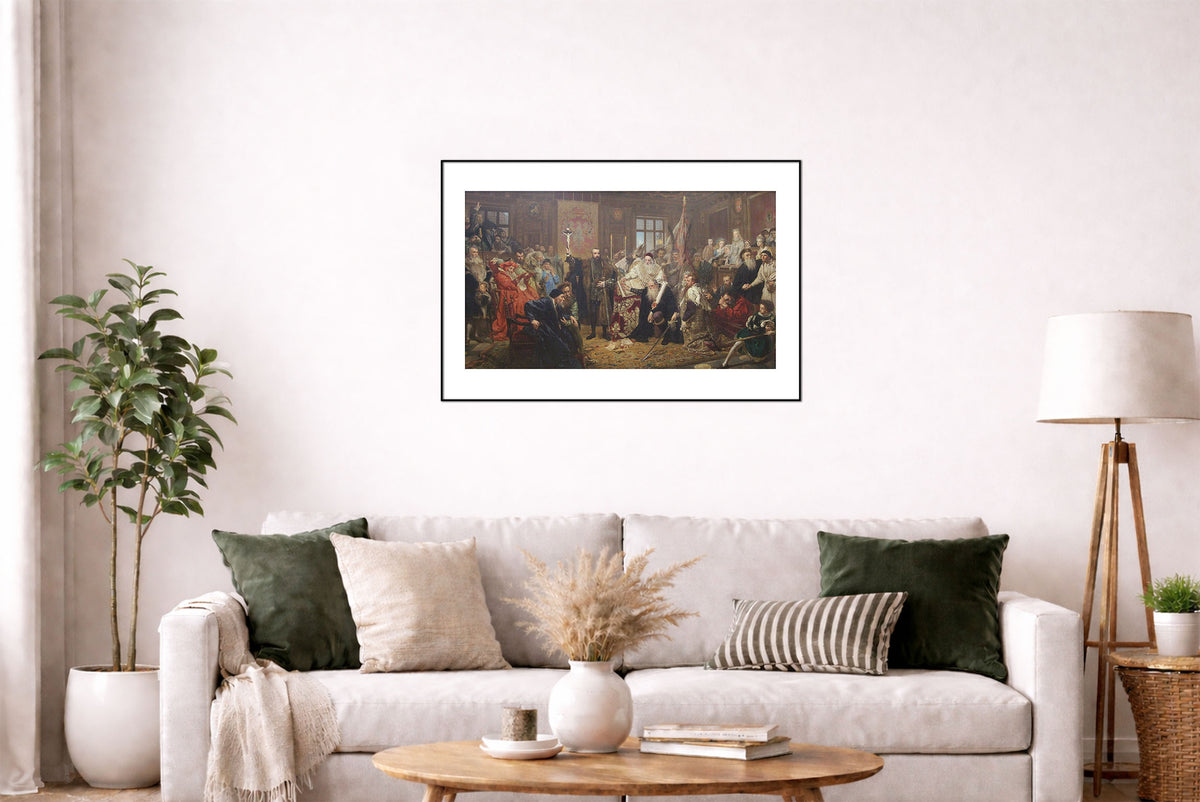
This is a reproduction print of the monumental historical painting “The Union of Lublin” (Unia lubelska), created by Polish painter Jan Matejko in 1869. The artwork commemorates one of the most significant political events in Central and Eastern European history: the Union of Lublin, signed on July 1, 1569, which established the Polish–Lithuanian Commonwealth. By uniting the Kingdom of Poland and the Grand Duchy of Lithuania into a single political state, the agreement created one of the largest and most influential countries in early modern Europe. The original painting is housed at the National Museum in Lublin, Poland.
The composition portrays King Sigismund II Augustus surrounded by Polish and Lithuanian nobles, clergy and political representatives during the historic negotiations in Lublin. The monarch stands prominently holding a crucifix, symbolizing the solemn character of the agreement and his central role in bringing the two nations together. Among the assembled figures are representatives of the political elites whose decisions shaped the future of the Commonwealth. Rather than reconstructing one exact moment, Matejko combines historical personalities and symbolic gestures into a dramatic interpretation of the creation of the Polish–Lithuanian state.
Matejko's painting is distinguished by its monumental scale, richly detailed Renaissance costumes, expressive portraits and carefully arranged historical figures. The artist uses dramatic lighting, elaborate textiles and ceremonial objects to emphasize the political and cultural importance of the event. The densely populated composition reflects the complexity of the negotiations and the diversity of the territories represented. As in many of Matejko's historical paintings, historical reconstruction is combined with patriotic symbolism, transforming a political agreement into a powerful visual narrative of national history.
Painted in oil on canvas, the original artwork measures approximately 298 × 512 cm. Completed in 1869 to commemorate the 300th anniversary of the Union of Lublin, it was created during the period when Poland and Lithuania had lost their independence following the partitions of the Polish–Lithuanian Commonwealth. Matejko used historical painting to preserve the memory of the former state and its political achievements. The Commonwealth established in 1569 survived until its final partition in 1795 and became known for its elective monarchy, parliamentary traditions and diverse population. Today, “The Union of Lublin” remains one of the most important artistic representations of Polish and Lithuanian history, the Jagiellonian dynasty and the political heritage of the Polish–Lithuanian Commonwealth.