Artist: Manuel Domínguez Sánchez
Year: 1871
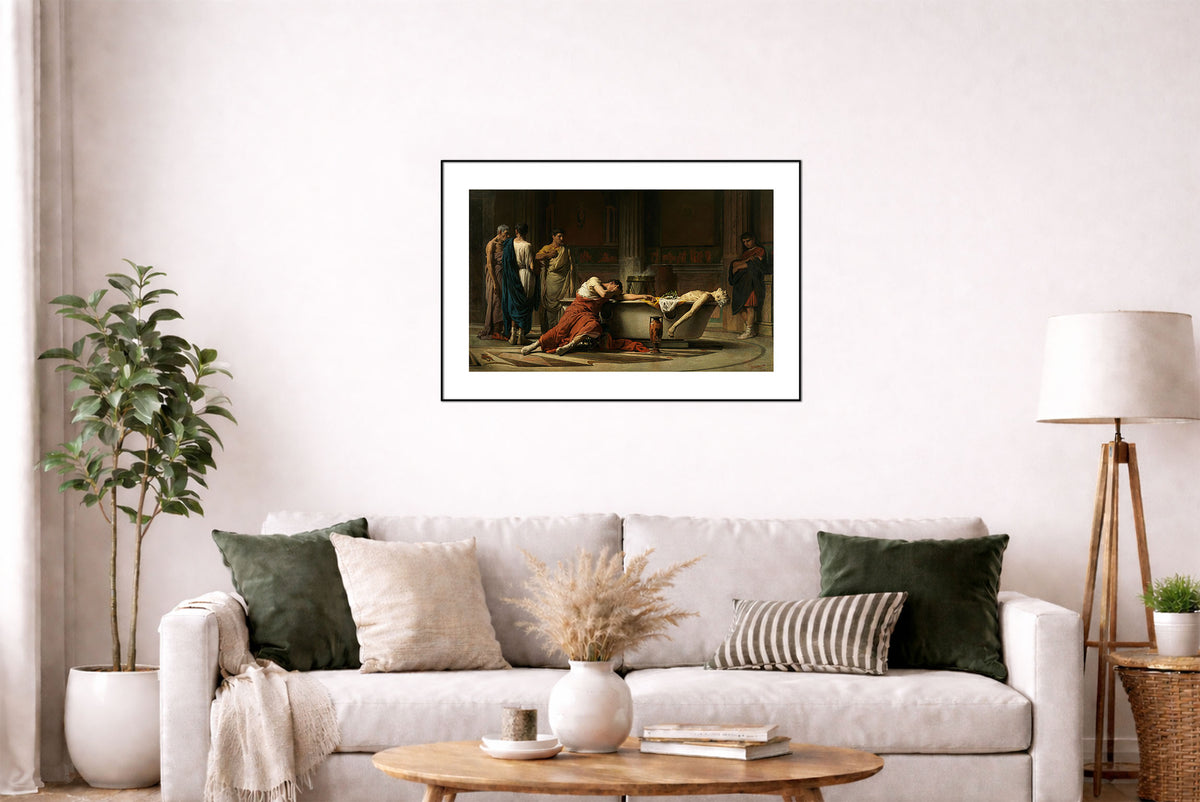
This is a reproduction print of the historical painting “The Death of Seneca” (La muerte de Séneca), created by Spanish painter Manuel Domínguez Sánchez in 1871. The artwork depicts the final moments of Lucius Annaeus Seneca, the Roman Stoic philosopher, statesman and former tutor of Emperor Nero, who was ordered to take his own life in AD 65. Combining the dramatic traditions of 19th-century academic painting with a subject drawn from classical antiquity, the painting explores themes of philosophical courage, political tyranny and dignity in the face of death.
The scene illustrates the aftermath of the Pisonian conspiracy against Emperor Nero, an unsuccessful plot to overthrow the Roman ruler. Although Seneca's involvement remains uncertain, Nero accused his former adviser of complicity and ordered his death. According to the Roman historian Tacitus, Seneca accepted the sentence with composure, surrounded by friends and members of his household. He opened his veins, and when death came slowly, further measures were taken to end his life. His wife, Pompeia Paulina, also attempted to die alongside him, but survived after Nero ordered her life to be preserved.
Domínguez Sánchez presents this tragic episode through a dramatic arrangement of figures, expressive gestures and carefully controlled lighting. Seneca appears as the central figure, surrounded by those witnessing his final moments. The classical setting, period costumes and emotional responses of the surrounding characters emphasize the contrast between the philosopher's composure and the grief of his companions. The artist draws upon the conventions of Spanish academic history painting, combining archaeological detail with a theatrical interpretation of one of ancient Rome's most memorable philosophical narratives.
Painted in oil on canvas, the artwork belongs to the tradition of large-scale historical painting that flourished in Spain during the 19th century. Domínguez Sánchez received significant recognition for this work, which reflects the era's fascination with the moral lessons of classical history. Seneca's writings on virtue, reason, self-discipline and mortality continued to influence European philosophy long after his death. “The Death of Seneca” remains a compelling artistic interpretation of Stoic philosophy, the reign of Emperor Nero and the political tensions of the early Roman Empire.