Artist: Jan Matejko
Year: 1884
Artistic period: Polish historical painting
Historical figure depicted: Wernyhora (Vernyhora), legendary Ukrainian bard and prophet
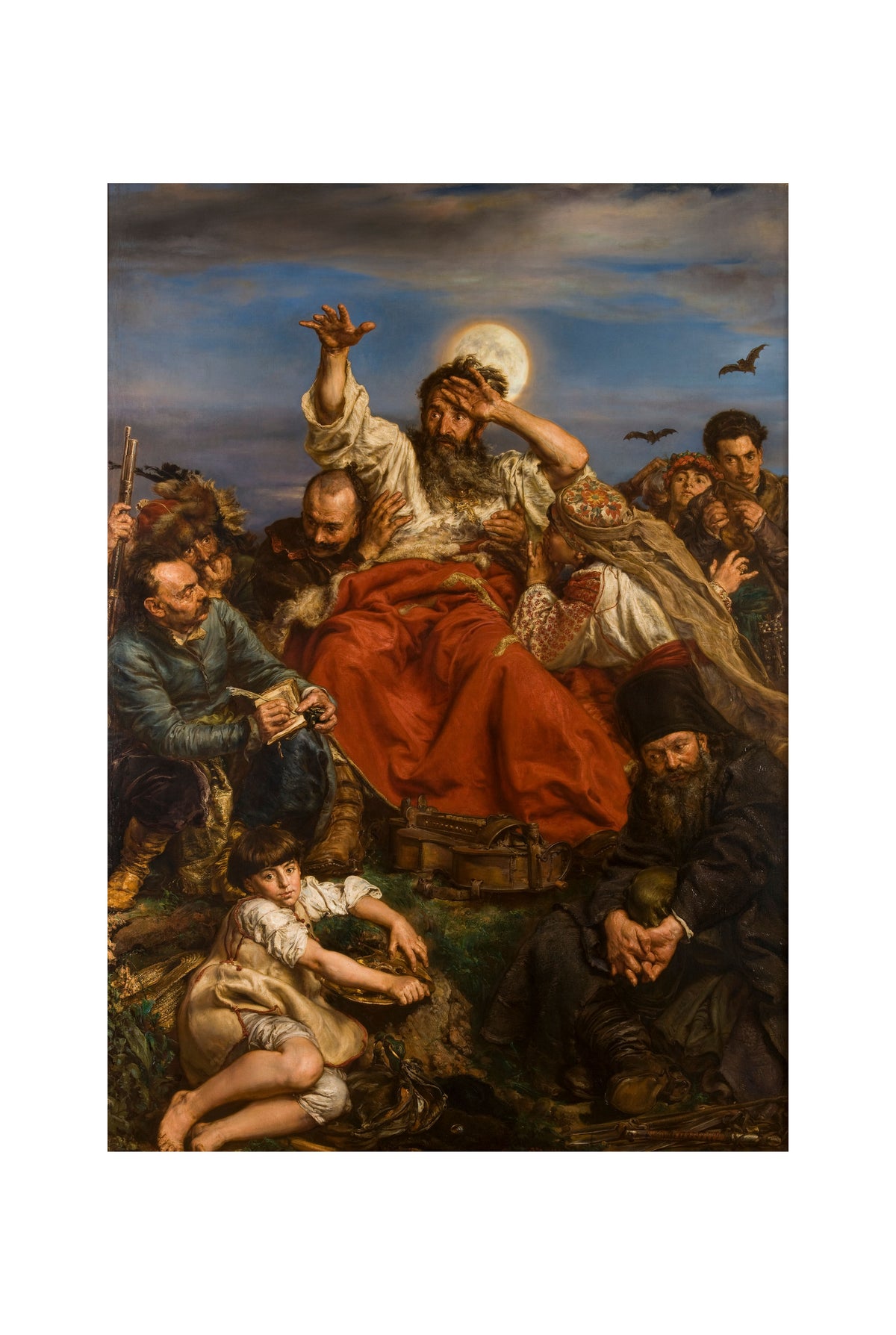
This is a reproduction print of the monumental historical painting “Wernyhora”, created by Polish painter Jan Matejko in 1884. The artwork depicts Wernyhora, a legendary Ukrainian bard and prophet, delivering a vision of the future to a gathering of listeners. Combining historical tradition, folklore and national symbolism, the painting explores the shared history of Poland and Ukraine, the fate of the Polish-Lithuanian Commonwealth and the hope for national renewal. The original artwork is housed at the National Museum in Kraków, Poland.
Wernyhora, also known as Vernyhora, is a mysterious figure associated with Ukrainian folklore and Polish Romantic literature. Traditionally described as an elderly Cossack bard and seer living in the 18th century, he was believed to possess the ability to predict major historical events. His historical existence remains uncertain, and the prophecies attributed to him survive primarily through legends and later literary traditions.
According to the most influential versions of the legend, Wernyhora foretold the decline of the Polish-Lithuanian Commonwealth, the suffering of its peoples and the eventual restoration of Polish independence. His predictions also became associated with the possibility of reconciliation between Poles and Ukrainians after centuries of shared history and periods of violent conflict. In Polish culture, Wernyhora gradually developed into a symbol of prophecy, national destiny and the hope for cooperation between neighboring nations.
Matejko places the elderly prophet at the center of a dramatic gathering, seated with his arms extended and his face illuminated as he delivers his vision. His white hair, long beard and traditional clothing give him the appearance of a biblical prophet. Around him, figures representing different social backgrounds listen with expressions of wonder, concentration and uncertainty. The contrast between the prophet's commanding presence and the reactions of his audience creates a scene filled with spiritual and emotional tension.
The painting incorporates richly detailed historical costumes, expressive gestures and carefully arranged figures, characteristic of Matejko's monumental historical compositions. Rather than reconstructing a precisely documented event, the artist presents a symbolic moment in which folklore becomes a vehicle for reflection on the historical destiny of nations. Wernyhora's prophetic message transcends the immediate gathering, suggesting a vision of the future shaped by political upheaval, suffering and eventual renewal.
The historical background of the painting is closely connected with the Polish-Lithuanian Commonwealth and its Ukrainian territories. For centuries, much of present-day Ukraine formed part of the Commonwealth, where Polish, Ruthenian, Jewish and other communities lived within a complex political and cultural environment. Relations between the Commonwealth's authorities, nobility and Cossack populations were marked by cooperation as well as serious tensions, including the Khmelnytsky Uprising of 1648. These historical experiences became central themes in later Polish and Ukrainian interpretations of the past.
The artwork was completed in 1884, when Poland remained partitioned between Russia, Prussia and Austria. In this context, Wernyhora's legendary prophecies carried particular significance for Polish audiences. Matejko's painting reflects the 19th-century fascination with national identity, historical memory and the possibility of restoring political independence. It also reveals the importance of Ukrainian themes in Polish Romantic and historical imagination.
Painted in oil on canvas, the original artwork measures approximately 290 × 204 cm. Jan Matejko (1838–1893) was one of Poland's greatest historical painters, celebrated for monumental works exploring the political, military and cultural history of Poland and the Polish-Lithuanian Commonwealth.
Today, “Wernyhora” remains one of Matejko's most evocative historical compositions, admired for its dramatic portrayal of prophecy, Polish-Ukrainian historical connections, national identity and the enduring hope for freedom and reconciliation.